
I have recently completed my 2nd-year exams, so I understand how confusing the time after 12th grade can be.
We spend around 14 years in formal education, but after completing those years, many students still do not know exactly what they want to do, which field they should choose, or how they will eventually earn. If you are at an earlier stage of this journey, learning how to choose your career path after Matric in Pakistan can help you start thinking about your options more clearly.
Education gives us basic knowledge, awareness, discipline, and a foundation for life, but a degree alone does not automatically guarantee financial success. In my view, students should think about both education and practical skills when planning their future.
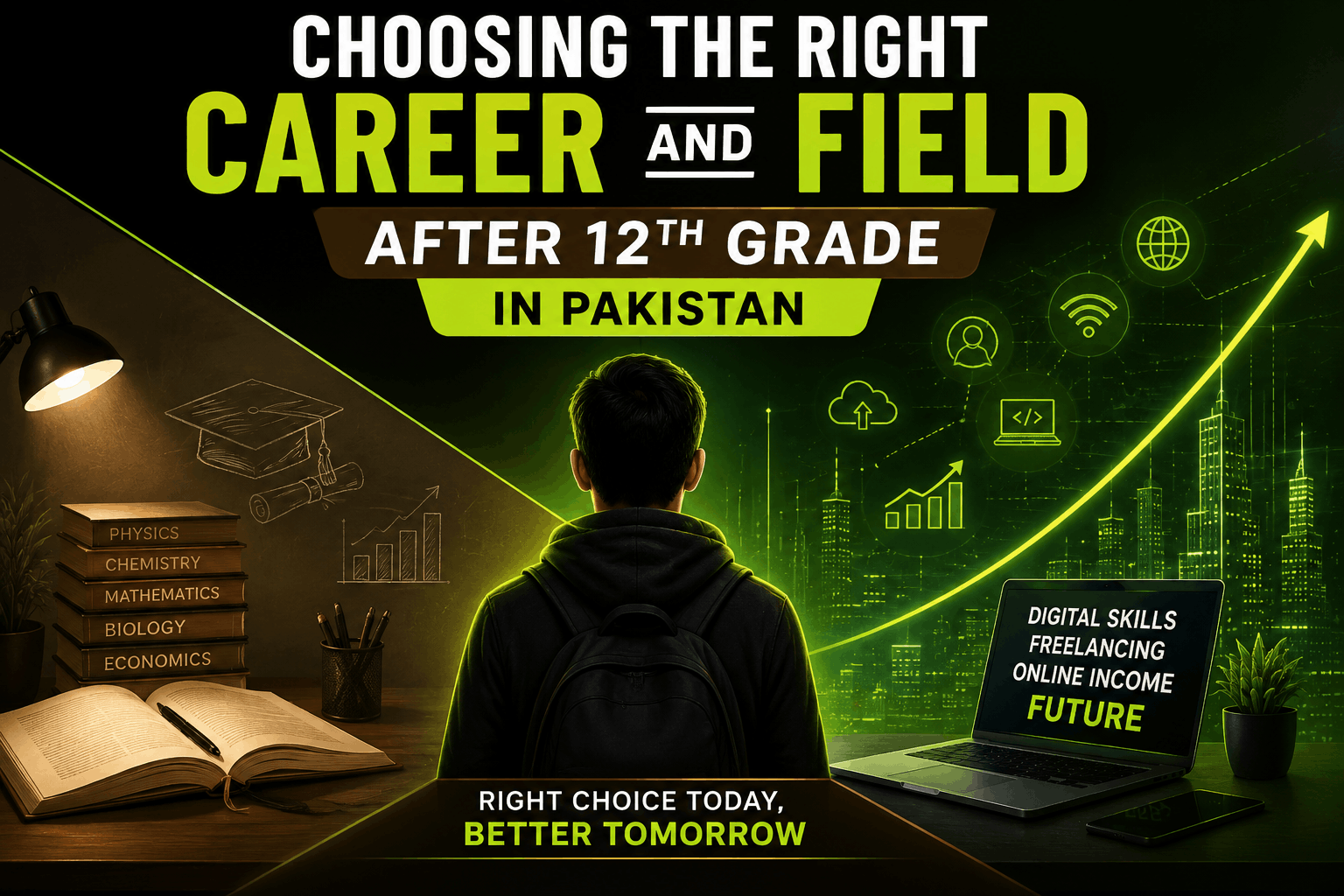
Study vs Digital Skills: What Could the Future Look Like?
If you are the son or daughter of a politician or an elite family,
you may have access to universities like Oxford, MIT, or Harvard. But for an ordinary student, education alone does not guarantee success or a high income. Many of the technologies we use today,
including the internet, were built through practical work, innovation, and entrepreneurship—not simply by collecting degrees.
And remember: studying does not mean memorizing books just to pass exams. Real education should build your thinking, skills, character, and ability to solve problems.
If four years of university only give you a degree without practical skills or direction, you may be wasting an important part of your time.
If your goal is to become a successful entrepreneur or build a strong business, start developing practical and digital skills alongside your education.
The digital world is creating a new generation of opportunities, and students should seriously consider being part of it.
Why the Next Four Years Matter After 12th
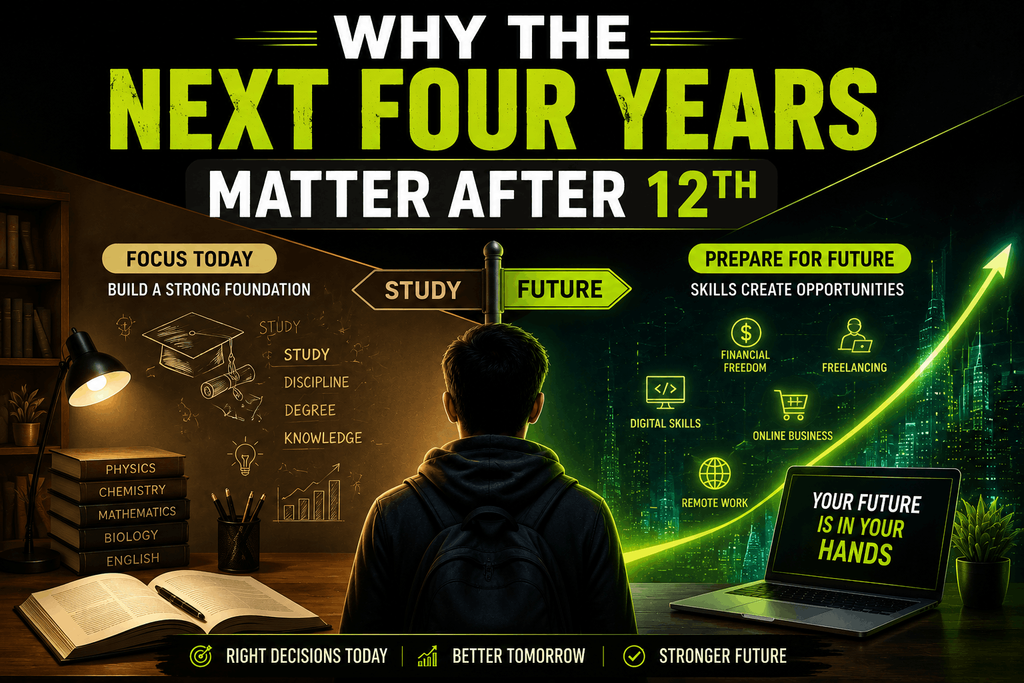
After 12th grade, students often think they have plenty of time. However, the next few years can be very important for building their future.
Many students spend the period after their exams doing nothing productive, while others immediately join random short courses or simply follow what their friends are doing. A better approach is to use these years to build a degree, practical skills, experience, and a clear career direction.
Education is not useless. It can improve your knowledge, confidence, opportunities, and social position. But students should also understand how they can turn their education into practical value.
What Students Usually Do After 12th
After Intermediate, students generally fall into a few common groups:
- Short-course students: They join two- to six-month computer courses without knowing where those skills will take them.
- Foreign education students: They start looking for universities and study opportunities abroad.
- Entrance-test students: They prepare for MDCAT, ECAT, or university admission tests.
- Result-waiting students: They simply wait for their results and spend several months without a clear plan.
The problem is not taking a short course, preparing for a test, or waiting for results. The problem is doing these things without a clear purpose.
How to Choose the Right Career After 12th
There is no single best career for every student. Before choosing a degree, ask yourself a few simple questions:
- What subjects do I enjoy?
- What am I naturally good at?
- Do I enjoy technical, creative, business, medical, or communication-related work?
- What can my family realistically afford?
- What jobs can this degree lead to?
- Do I want to work in Pakistan or abroad?
- What skills will I need besides my degree?
- What kind of lifestyle and working environment do I want?
Do not choose a field only because someone says it has “high scope.” A popular field can still be the wrong choice for you.
Best Career Options After 12th by Academic Stream
FA Students: Arts and Humanities
FA students have more options than many people think. Some possible fields include:
- BS English
- BS Psychology
- Clinical Psychology
- BS Economics
- Nutrition and Dietetics
- Education
- Social Sciences
- History
- Media and Communication
BS English can be useful for teaching, communication, content creation, online education, and other language-based careers. Psychology can suit students interested in human behavior and counseling, while Economics and Social Sciences can provide pathways into research, education, business, and public-sector careers.
FSc Pre-Medical Students
Medical students do not have only one option: MBBS.
They can consider:
- MBBS
- BDS
- Pharm-D
- BS Nursing
- Biotechnology
- Microbiology
- Zoology
- Botany
- Nutrition
- Allied Health Sciences
- Paramedical programs
Students can also explore specialized programs such as laboratory technology or operation-theatre-related training.
However, do not choose a healthcare field simply because it sounds respected. Understand the study duration, professional requirements, daily work, costs, and career pathway before making your decision.
FSc Pre-Engineering Students
Pre-Engineering students can explore:
- Electrical Engineering
- Mechanical Engineering
- Civil Engineering
- Aerospace Engineering
- Aeronautical Engineering
- Software and computing-related programs where eligible
Engineering can be a good path for students who genuinely enjoy mathematics, science, technical subjects, and problem-solving.
ICS Students
ICS students have many options in the technology sector:
- BS Computer Science
- Software Engineering
- BS Information Technology
- Artificial Intelligence
- Machine Learning
- Computer Engineering
- Cybersecurity
- Data-related fields
But remember one important thing: a technology degree alone does not guarantee a technology career. Students should build projects, portfolios, communication skills, and practical experience while studying.
I.Com Students
Commerce students can consider:
- CA
- ACCA
- BS Accounting & Finance
- BBA
- Economics
- Banking and Finance
- Marketing
- Entrepreneurship
Students interested in accounting may prefer professional qualifications, while those interested in management, business, sales, or startups may find BBA and related fields more suitable.
Degree + Digital Skill: My Personal Recommendation
This is one area I strongly think students should consider.
We have already spent around 14 years studying. If you spend another four years completing a degree, I believe it is also smart to use those years to learn a practical digital skill.
The internet created a major new opportunity around 20–25 years ago. Many people who entered online businesses, technology, websites, and digital industries early were able to build successful careers and companies. Today, I believe another major digital race is developing because of AI, automation, online businesses, remote work, and digital services.
For students in Pakistan and other Asian countries, this can be especially interesting because online work can sometimes provide access to international clients and dollar-based income.
My suggestion is not to leave education. Instead, consider:
Degree + Digital Skill + Practical Experience
Some skills students can explore include:
- Blogging
- SEO
- Freelancing
- Digital marketing
- Web development
- Content creation
- Other online services
If you have a laptop, internet access, patience, and a willingness to work consistently, you can start learning these skills without waiting until graduation.
What About YouTube?
YouTube can be an option, but I would not recommend entering it simply because you think it is easy money.
Many people start channels expecting quick results, but most do not become successful immediately. Today, AI also makes it very easy to produce large amounts of low-effort content.
If you want to try YouTube, focus on:
- An original idea
- A different presentation style
- Useful or entertaining content
- Your own research and creativity
- Consistency
- Building a real audience
Do not assume that every AI-generated video will become successful or that YouTube automatically provides high income.
What About Trading?
I would personally not recommend trading as the first digital-income path for a student.
Trading requires capital, knowledge, risk management, and emotional control. Social media often shows people making money but does not always show their losses or risks.
For a beginner, learning a genuine skill such as SEO, blogging, freelancing, programming, or digital marketing may be a more practical starting point.
What Careers Is Gen Z Interested In?
Today’s students are increasingly interested in:
- AI and technology
- Software development
- Freelancing
- Remote work
- Digital marketing
- Entrepreneurship
- Content creation
- Healthcare
- Finance
But popular does not always mean suitable.
Do not choose AI just because everyone is talking about AI. Do not choose CS just because people say it has scope. First ask whether you actually enjoy the work.
What About Career Options for Girls in Pakistan?
There is no single career that is automatically best for girls. Women can build careers in:
- Healthcare
- Education
- Psychology
- IT
- Finance
- Marketing
- Law
- Business
- Entrepreneurship
- Remote work
Instead of asking which profession is “for girls,” consider the working environment, flexibility, qualifications, career growth, earning opportunities, and personal interests.
Common Mistakes Students Make After 12th
Avoid these mistakes:
- Choosing a degree because friends are choosing it
- Following a field only because it has “scope”
- Selecting a career only for social status
- Ignoring the total cost of education
- Choosing a university without researching its program
- Assuming a degree guarantees a job
- Spending four years without learning practical skills
- Taking random short courses
- Believing every online-income advertisement
- Having no backup plan
What Should You Do Before Choosing Your Degree?
Before making your final decision, follow these steps:
- Identify your strongest subjects.
- Shortlist three to five possible careers.
- Research the degrees required for those careers.
- Compare universities and programs.
- Check the total cost.
- Talk to someone already working in the field.
- Learn what the daily work actually looks like.
- Try a relevant skill or small project before committing.
- Think about Pakistan and international opportunities.
- Create a Plan A and Plan B.
Final Thoughts
Choosing a career after 12th is a major decision, but it does not have to be frightening. You do not need to find a magical “number one career.” You need to understand yourself, research your options, and choose a direction that fits your abilities, interests, financial situation, and goals.
As someone who has recently completed 2nd-year exams, my biggest suggestion is simple: do not spend the next four years only collecting a degree. Use those years to build yourself.
Continue your education if the degree is right for you, but also consider learning a practical digital skill. Build experience, create projects, understand the online world, and stay ready for changes brought by AI and technology.
Your degree can give you a foundation. Your skills and experience can help you turn that foundation into real opportunities.
The goal should not be just to complete 16 years of education. The goal should be to become capable, skilled, adaptable, and ready to earn and build a career in the changing world.
Digiton Emperor is the Founder and Editorial Lead at ReadItForward, an educational platform focused on providing useful and accessible study resources for Pakistani students. He oversees the website’s content, research, publishing standards, and resource organization.
ReadItForward aims to provide clear and practical educational information while encouraging students to verify important academic updates with their respective official education boards.
3 thoughts on “Choosing the Right Career and Field After 12th Grade in Pakistan”