
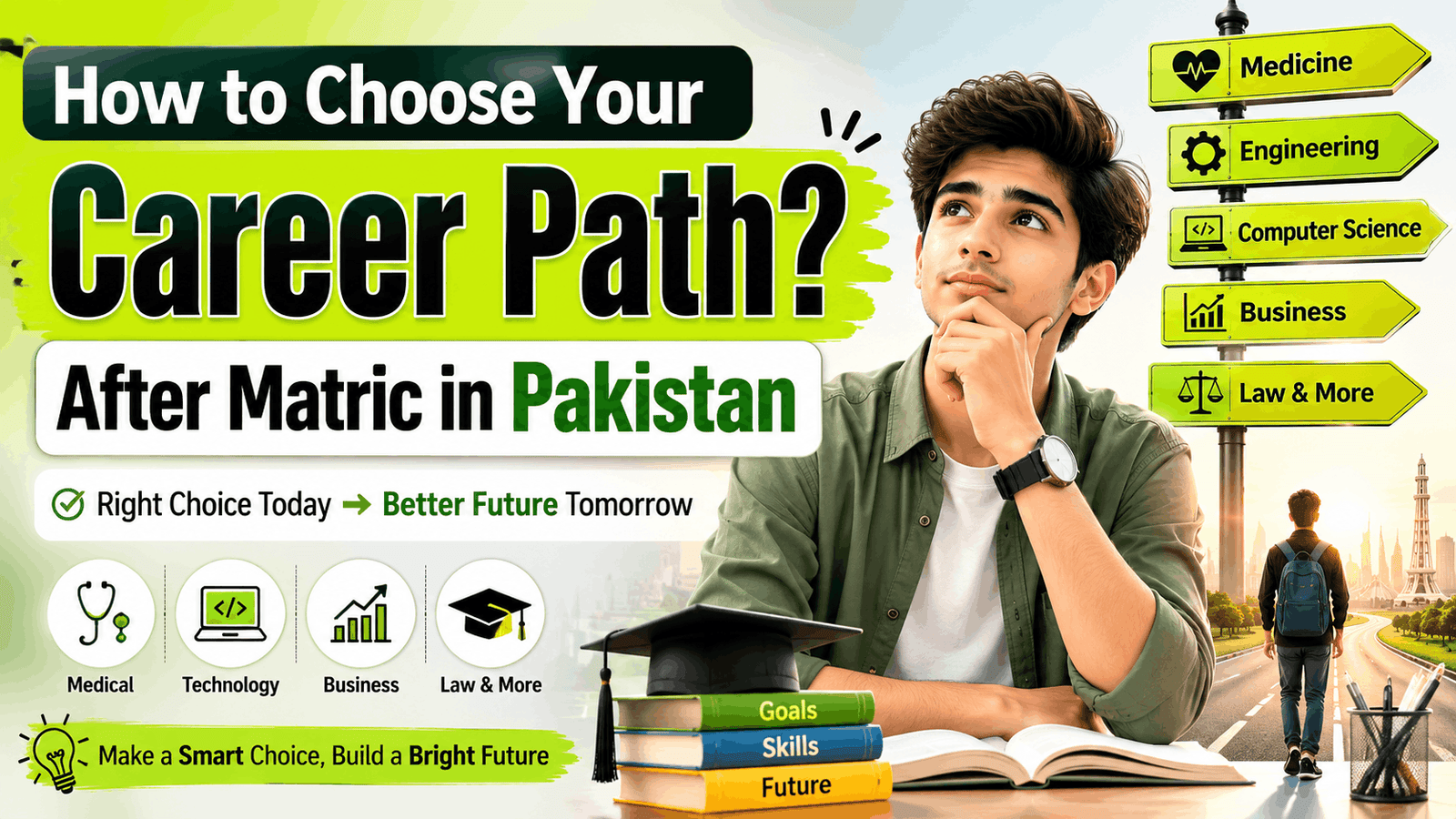
Choosing a career path after matric is one of the biggest decisions a student in Pakistan has to make. At this stage, students often hear the same suggestions from parents, relatives, teachers, and friends: become a doctor, choose engineering, study computer science, join the armed forces, or prepare for a government job.
But choosing a career should not be about simply following the most popular option. It should be about understanding who you are, what you can do, what opportunities are available, what your family can support, and how the career may change in the future.
Career counseling is becoming more important for Pakistani students because there are now many more education and career options than the traditional choices. Good career guidance can help students understand their interests, strengths, skills, and abilities before choosing a direction.
💡 Helpful Tip: If you want to explore this topic further, read our guide on Choosing the Right Career and Field After 12th Grade in Pakistan .
So, if you have completed matric and are confused about what to do next, do not make the decision in a hurry. Take some time to understand your strengths, interests, family situation, and future career opportunities before choosing your next step.
How to Choose Your Career Path? Dr Rafiq Dar with Qasim Ali Shah
Career Advice vs. Career Counseling
| Career Advice | Career Counseling |
|---|---|
| Tells the student what to do. | Helps the student explore suitable options. |
| Often focuses on one recommended career. | Considers multiple possible career paths. |
| The decision may be imposed by someone else. | The student makes an informed decision. |
| Example: “You should become a doctor.” | Example: “Let’s explore which career fits your abilities, interests, and goals.” |
One of the most important ideas in career planning is understanding the difference between advice and counseling.
If someone tells a student, “You should become a doctor,” that is advice.
It may come from a good intention, but it does not necessarily consider whether the student actually has the interest, ability, personality, financial resources, or long-term goals required for medicine.
Career counseling is different.
Instead of imposing one profession on the student, proper counseling explores several possible options. The student can understand the advantages, disadvantages, requirements, and future possibilities of those options before making a decision.
The goal is not for the counselor to say:
“This is the career you must choose.”
The goal is to help the student reach a point where they can say:
“After understanding my options, I believe this is the right path for me.”
That difference can have a major impact on a student’s future.
Why You Should Think Carefully Before Choosing a Career
A common problem is choosing a degree or field without understanding it properly.
A student may select a career because friends are doing it. After two or three years, they may discover that they dislike the subject or cannot handle the demands of the profession. They then change their field and start again.
Changing direction is sometimes necessary, but repeatedly choosing careers without proper planning can cost years of education, money, effort, and motivation.
This is why career planning should begin before you commit to a long educational path.
After matric, you don’t need to know exactly what you will be doing 20 years from now. However, you should have enough information to choose your next educational step intelligently.
5 Important Factors to Consider Before Choosing a Career
The most useful approach is to look at several factors together rather than choosing a career based on one thing.
1. Scope and Your Ability
The first question should be:
Does this career have opportunities, and do I have the ability to succeed in it?
Students often focus only on “scope.”
They hear that a particular profession has a good future and immediately decide to pursue it.
But a career can have excellent opportunities and still be a poor choice for a particular student.
For example, a student may hear that computer science and AI are promising fields. But if the student has no interest in technology, dislikes problem-solving, and has no willingness to develop technical skills, simply choosing the field because it is “high scope” may not produce the expected results.
Similarly, medicine may be a respected career, but it requires serious academic commitment and a willingness to handle years of education and professional training.
Ask yourself:
- What are my strongest subjects?
- What type of work do I naturally enjoy?
- What skills do I already have?
- What skills am I willing to develop?
- Can I handle the academic demands of this career?
- Does the daily work of this profession suit me?
Scope matters, but personal ability matters too.
2. Family and Financial Support
Your family situation is another important part of career planning.
Education in Pakistan can involve significant expenses. Some programs require expensive tuition, equipment, transportation, accommodation, or several years of study before a student can enter the workforce.
Therefore, before choosing a career, ask:
Can my family realistically support this educational path?
Consider:
- Tuition and admission costs
- Duration of education
- Transportation or accommodation
- Additional training requirements
- Availability of scholarships
- How long it may take before you start earning
This does not mean that students from financially limited families should abandon ambitious careers.
It means they should plan more carefully.
A student with limited resources may benefit from exploring fields where valuable skills can be developed through affordable education, scholarships, practical training, or flexible learning opportunities.
The goal is to find the best balance between education cost, career potential, skill development, and financial reality.
3. Look at Future Opportunities, Not Just Today’s Market
This is one of the most important parts of career planning.
Don’t only ask:
“Does this field have scope today?”
Ask:
“What could this field look like when I finish my education?”
If you start an educational program after matric and spend several years studying, the job market may change significantly before you graduate.
Technology is changing industries rapidly. Artificial intelligence, automation, digital platforms, and new business models are already affecting the skills employers need.
Therefore, students should speak with experienced professionals and mentors and ask:
“Where do you see this profession going in the next five to ten years?”
This is much more useful than simply looking at what is trending on social media today.
Future-proofing does not mean finding a career that can never be affected by technology.
It means developing the ability to learn, adapt, and remain useful as the industry changes.
4. Don’t Follow Passion Blindly
“Follow your passion” is common career advice, but passion alone should not be the entire decision.
Imagine that a student loves teaching. That passion may be genuine and valuable. But the student also needs to understand the income potential, demand, career growth, and lifestyle associated with different teaching opportunities.
The real question is not:
“Passion or money?”
A better question is:
“Can I combine what I enjoy with what I am good at and what the market needs?”
A practical career decision should consider:
Interest + Ability + Market Demand + Financial Reality
Passion can keep you motivated, but financial sustainability is also part of a successful career.
Choosing something you love without considering whether it can realistically support your future can create problems later.
5. Consider Your Environment
The final factor is your environment.
Your career does not exist in isolation. Your family, financial situation, educational opportunities, location, social environment, and access to mentors can all affect your options.
For example, a student from a business-oriented family may have early exposure to entrepreneurship and business. A student from a family involved in law or public service may have different professional exposure and networks.
This does not mean that family background should decide your career.
It means that your circumstances should be considered when planning your path.
A good career decision is personalized rather than based on a universal formula.
What Career Options Can Students Explore After Matric?
After matric, Pakistani students have several possible educational directions. The right choice depends on their subjects, academic performance, interests, abilities, finances, and long-term goals.
Students interested in medicine and healthcare may consider science-related pathways that can eventually lead to medicine or other healthcare professions.
Students interested in mathematics, technology, computers, and engineering may explore pathways related to computing, engineering, software, AI, data, and other technical fields.
Students interested in business, accounting, finance, or entrepreneurship can explore commerce and business-related education.
Students interested in law, psychology, media, education, humanities, or social sciences can explore relevant academic pathways.
There are also technical and vocational routes for students who prefer practical, hands-on learning.
The important point is that doctor and engineer are not the only successful careers available today.
The career landscape is much broader than it was for previous generations.
Why Technical Skills Matter
For students who need to become financially independent relatively early, specialized technical skills can be particularly valuable.
Technology-related fields such as software development, AI, data, cybersecurity, and other digital professions continue to evolve. At the same time, healthcare contains many specialized careers beyond becoming a doctor, including areas such as physiotherapy, medical laboratory technology, and biochemistry.
However, students should not choose AI, computer science, or another technical field simply because someone says it has “scope.”
Even modern careers require the right aptitude, interest, discipline, and willingness to keep learning.
The same principle applies to healthcare, business, law, and every other field.
There is no single best career for every student.
Should Your Financial Background Decide Your Career?
Your financial background should influence your strategy, not determine your entire future.
A student from a lower-income or lower-middle-income family may need to prioritize affordable education, scholarships, practical skills, and career paths that offer realistic earning opportunities.
A student from a financially stronger family may have more freedom to explore entrepreneurship, business, specialized education, or longer educational pathways.
But neither situation automatically determines what a student should become.
Your circumstances are one part of the decision.
Your abilities and goals are another.
The best career plan connects both.
Don’t Let Parents or Relatives Impose a Career
Parents naturally want their children to succeed. Their experience and advice can be extremely valuable.
But there is a difference between guiding a child and imposing a career on them.
Statements such as:
- “You must become a doctor.”
- “Engineering is the only good option.”
- “Everyone in our family is a lawyer.”
- “Your cousin is doing this, so you should do it too.”
may create pressure rather than clarity.
A student is the person who will eventually study the subjects, work in the profession, face its challenges, and live with the consequences of the decision.
Parents should therefore participate in the process, but students should also have a voice in the final decision.
A Simple Career-Selection Checklist
Before selecting your next educational path after matric, write down these questions and answer them honestly:
1. What am I good at?
2. What subjects and activities genuinely interest me?
3. What careers match my abilities?
4. What education and skills does each career require?
5. Can my family realistically support this path?
6. What could the industry look like five to ten years from now?
7. What earning and growth opportunities might exist?
8. Does the career fit my personality and environment?
9. Am I choosing this because I want it, or because someone is pressuring me?
10. Have I spoken to someone with real experience in this field?
Your answers can help you narrow a long list of careers into a few realistic options.
When Should You Consider Professional Career Counseling?
If you are still confused after researching your options, professional career counseling can be a useful next step.
A proper counseling process should look at more than your marks.
It may consider your aptitude, personality, interests, strengths, educational background, goals, and available career options. Pakistani career-counseling services commonly describe this kind of assessment-based approach rather than simply recommending a profession based on one factor.
The purpose of counseling should be to give you clarity, not to take away your ability to choose.
Before spending several years and significant money on a degree, investing in a professional assessment may be worth considering if you genuinely cannot decide between multiple paths.
Final Thoughts
Choosing your career path after matric in Pakistan is not about finding the profession that everyone calls “the best.”
It is about finding a path that makes sense for you.
Look at your:
Ability.
Interests.
Family and financial situation.
Future opportunities.
Environment.
Career goals.
Don’t choose a field simply because it is popular today.
Don’t choose it only because your relatives want it.
Don’t choose it only because it pays well.
And don’t choose it only because you are passionate about it.
Instead, bring these factors together and make an informed decision.
Most importantly, remember the difference between advice and counseling. Someone can give you suggestions, but the purpose of proper career counseling is to help you understand your options so that you can make the decision yourself.
Your first decision after matric does not have to define every detail of your life. But it should be a thoughtful next step—one based on who you are, what you can become, the realities of your circumstances, and the direction in which the world of work is moving.
The right career is not necessarily the career with the biggest name. It is the career in which your abilities, interests, opportunities, and future goals can work together.
1 thought on “How to Choose Your Career Path? After Matric in Pakistan”